Monday, April 18, 2011

Using the Jump Rope To Improve Endurance, Coordination, Agility & Reacti...


Jumping rope is an effective and inexpensive way to improve your cardiovascular fitness, coordination, agility and lower body ground-reactive speed. Unlike treadmills and elliptical trainers costing thousands of dollars, a jump rope costs a mere $5-$50 depending on the quality. It also packs neatly into a gym bag, which allows you to jump rope anywhere with just a minimal amount of open space required. Although boxers have a long tradition of using the jump rope for conditioning, the benefits of the exercise can be shared by everyone from the general gym enthusiast to elite athletes of all sports. Jump ropes come in different lengths and various designs to suit a variety of fitness levels and goals.


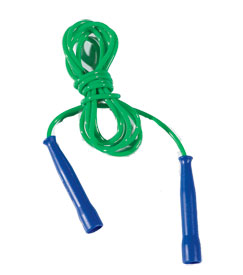
This is a low quality jump rope constructed with low grade plastic. Even if you are a novice skipper, I suggest you spend some extra money on a jump rope with better craftsmanship and performance. This rope is suited for the playground, rather than a gym. What did you expect for $5?


A string rope covered by hard plastic beads with foam grip ball bearing swivel handles. Good for multiple persons usage and jumping outdoors. Beware, hard impact across the floor or ground can cause parts of the beaded chain to break off. Also, the beaded chain tends to shift while in use making the turning action feel unbalanced and sluggish.


Leather ropes are quite durable, but difficult to turn to achieve high speed jumping. If you are a casual jump rope user, the slower pace might be of benefit. There are a range of handles associated with this type of rope which include: foam, wood, swivel and weighted. This rope is good for novice and multiple users.


Stainless steel ropes are virtually impossible to break and give good over-all performance. However their rigid construction is not good for performing rope stunts. Also accidentally whipping yourself in the leg with a metal rope is extremely painful. This rope is good for the intermediate user.


This is the best jump rope that money can buy, and the one I personally use. It's perfectly balanced, turns with ease, light as a feather and is constructed of flexible high grade plastic with aluminum swivel handles covered with a foam grip. You can trick and skip as fast as grease lightening with this rope. Only down side is that it cost $50


High density rubber weighted jump rope is great for developing explosive power and strength. It comes in a variety of weighted sizes 1lb, 2lb, 3lb, 4lb, etc. However, if you are new to exercising with a jump rope, than you are probably not ready for the monster intensity this type of rope can deliver. This rope is good for expert jump rope users, who have the stamina and strength to turn this beast.


How To Jump Rope:


  1. First, make sure the jump rope is the appropriate length for you by placing one foot on the center of the rope against the floor, while at the same time holding a handle in each hand up towards your arm pits. If the handles reach your arm pits, the length of the rope is fine. Not the case, then adjust the length of the rope if possible, or obtain another rope that is more feasible.


  2. With the rope behind you touching the floor, extend your arms to your sides with the handles of the rope in hand.


  3. Rotate your arms up and forward which in turn will cause the jump rope to lift from the floor and begin rotating over your head.


  4. As your arms start to rotate down and back, it will prompt the jump rope to rotate towards the floor in front of you.


  5. When you hear the smacking sound of the rope against the floor this is your cue to jump over the rope to allow it to pass under both feet. At this time the arms should be back to their original starting position.


  6. Now you simply rotate the arms up and forward again to make pass after pass for as long as your routine calls for.

It's that simple. Practice these steps and you will be skipping like a pro in no time at all. Later on you can progress by adding stunts and weights to your routine as shown in the video.

Sunday, April 17, 2011

Boxing Highlight - Body Shot Knockouts


Anyone who doubts that a hard body shot is worst than a head shot, to convince yourself otherwise look at the faces of the downed fighters in this video.

A 45 degree upper-cut to the liver or kidney will drop any 'bad ass' in the ring; believe that!

Heavy Bag Drill For In Close Boxing


There is a good reason why some boxers don't like to fight on the inside of an opponent; it's brutal. A hard shot to the midsection will rip the life and soul out of your body. Besides the imminent threat of getting punched hard at close range, you often get one fighter draped over the shoulder or back of another during in fighting. It's very tiresome having to support your body weight in addition to partially supporting your opponent's body weight as well.

However, these are largely the concerns of pro-boxers; not amateurs. The international sanctioned rules of amateur boxing discourages inside boxing, because of how contests are scored at this level of the sport. Three judges sitting ringside have to simultaneously agree to award a point to a competitor. It is difficult for judges to see the action when fighters are in close. For this reason, amateur boxers are coached to punch at a distance and from a position in the ring that gives all the judges the best chance to see him/her land a shot. Regardless of the scoring rules, amateur boxers should still prepare for in fighting. Whether a hard body blow scores or not, it can still inflect major damage and grossly deflate an opponent's fortitude. Plus it is a valuable skill to carry over into the professional ranks, where fighting in close is prevalent.

Practicing on the heavy bag is a good way to prepare for dueling up close while working on other facets of your training such as core strength, strength endurance and upper body agility. The exercises I am doing in the video is not a fixed routine. I'm merely combining various Swiss ball exercises while punching in close proximity to the heavy bag. Halfway through the 3-minute round I stand up, and then I start simulating close range punching and defending. Unpredictable situations come up in the ring all the time. So I sometimes do a drill(s) with minimal structure. But you can progress this exercise as you like. I'm just the finger pointing the way.

Thursday, April 14, 2011

If It Ain't Broke, Don't Fix It!


Laugh! I'm still rocking the original PC+Mac 240 songs 1GB ipod Shuffle. I even have the box it came in, along with the purchase receipt. However, the original headphones broke ages ago. At present, I'm using Sony's active style neck-band headphones. They stay in place reasonably well while I'm working out. But their durability is questionable. I acquired the set in the picture, after previously purchasing the same model which broke in just 4 months.

Although, I don't appreciate having to buy the same headphones twice in such a short period, I think the Sony headphones are better than the ones Apple packages with its ipods. Apparently the Apple/Mac store in KLCC doesn't think much of their headphone product either. I noticed that branch is using Sinister headphones on some of their test model ipods. Hilarious!

I thought about replacing my outdated ipod Shuffle with a version that has 1000's of songs capacity. But quite frankly I'm not motivated enough to take the time to load a play list of more than a 100 songs. I primarily use my ipod for working out. During that time I'm not looking for variety in my music selection. I only want to hear songs that raise my level of aggression to insanity. I can do that with 1GB.

Wednesday, April 13, 2011

Basic Speed, Agility & Quickness Ladder Drills


The ladder is a training tool used to primarily improve speed, agility & quickness (SAQ). Being able to readily stop and go, change direction and move rapidly transfers into proficient sports performance. I frequently use ladder drills to better my footwork, coordination and ring generalship.


Covered in the video are basic drills that can be performed with a speed ladder, but there are a great number of exercises that can be progressively developed from these base maneuvers. For an exercise to be characterized as a speed drill; it must be performed with one's fastest effort. For this reason I recommend doing such drills in 10-20 second burst with 10-20 seconds of rest in between. If your short on stamina, it's advisable to take up to 60 seconds to recover.


Sample Speed Ladder Routine For A Boxer (work intervals based on a 3-minute round)


  1. Double-step lateral sprint - (15 seconds work, 15 seconds rest) x 2

  2. Double-step forward sprint - (15 seconds work, 15 seconds rest) x 2

  3. Forward lateral sprint or slalom - (15 seconds work, 15 seconds rest) x 2

  4. Ali shuffle - (15 seconds work, 15 seconds rest) x 2

  5. Lateral push up - (15 seconds work, 15 seconds rest) x 2

  6. Bear crawl - (15 seconds work, 15 seconds rest) x 2

Complete all the intervals in consecutive order followed by 1-minute of rest. Then you will perform the sequence two more times. Upon conclusion, the total number of work intervals will total three 3-minute rounds. Do these drills twice a week to be able to stop on the dime, and then change directions in the blink of an eye. Your opponents will pose like mannequins trying to keep pace.


Wear loose comfortable clothing, and athletic footwork that grips the training surface. Also do the drills on the balls of your feet to keep tension in the calf muscles to be able to spring quickly.

Monday, April 11, 2011

Rosalinda - Welcome To Malaysia Song


Rebecca Black eat your heart out, Rosalinda is taking me chopping and making happy in my hand. LMAO! Real life is better than fiction. You just can't make this shit up.

Kanye West - Monster ft. Nicki Minaj Parody! Key of Awesome #33!